Curatorial Essay and Project Concept
Hyelim Jeon, Project Director
1. To explore how media-based narratives have programmed us and reflect on contemporary media-cultural and cognitive systems.
Our project stems from the idea that media-based narratives play a crucial role in reflecting contemporaneity. However, the term ‘media’ here does not refer to the material sense of the medium as a physical substrate, but rather to its broader and more comprehensive meaning - encompassing both analog and digital forms.
We have become accustomed to copying and documenting how subjects are represented within media, making them integral to media platforms. Consequently, we have reached a stage where we objectify and perceive ourselves in a similar manner, recording our own lives within media environments and positioning ourselves as the protagonists of these narratives. I define this phenomenon as a ‘mediatic cognitive system’.
This narrative-focused, media-based mode of thinking is particularly prominent among our generation in Korea. In the 1980s, Korea emphasized the importance of soft power, subsequently developing cultural industries-including digital media-that significantly expanded the nation’s soft power.
As a result, narrative-driven films and dramas flourished, and we became increasingly capable of rapidly influencing and being influenced by online trends. Our generation, born after this critical moment, is the first to have lived entirely alongside advanced media technologies.
What kind of world are we living in?
Following the pandemic, our physical movements were restricted for a time, while online activity surged dramatically. People absorbed information and narratives at unprecedented speed, and cultural exchange occurred on a massive scale. Paradoxically, the world began to share the same trends. Even Germany, which had traditionally maintained a more conservative stance toward digitalization, has been steadily and rapidly embracing new technologies.
Throughout this process, individual experiences have influenced one another, transforming into new, original narratives.
So, in what kind of world-and as what kind of selves-do we live today? Change can be disorienting, and we must seek to understand how it is reshaping us.
This project serves as an experiment in interpreting and expressing diverse media-based narratives through artistic practice. It aims to generate artistic discourse on contemporary social issues-such as the merging of the virtual and the real, the challenges arising from the uncontrolled proliferation of AI-generated works, and questions of authorship and copyright. Furthermore, it seeks to document, through artistic means, generational characteristics and contemporaneity, fostering both intergenerational and international exchange, and allowing audiences to directly experience the influence of ‘mediatic cognition systems’ on individuals and society.
By building online communities and networks, the project intends to ensure its sustainability and to create new discourse that encompasses artistic, social, and technological possibilities.
2. Main Research Focus : Narrative Media
1-1) 'Narrative Media' and 'Mediatic Cognitive System': How has media programmed us, and in what ways has it shaped our cognition?
How is the concept of a 'mediatic cognitive system' interpreted and reflected in each artist’s work? Our cognitive processes have been increasingly-and often subtly-shaped throughout our lives by the development of digital media, becoming deeply embedded in our individual experiences, whether positively or negatively.
This project examines and documents, from each artist’s personal perspective, how mediaic cognitive systems have influenced their lives. The process evolved into artistic practice, with the exhibition exploring how each artist analyzes their individual mediatic cognitive system and translates it into visual form.
This project examines and documents, from each artist’s personal perspective, how mediaic cognitive systems have influenced their lives. The process evolved into artistic practice, with the exhibition exploring how each artist analyzes their individual mediatic cognitive system and translates it into visual form.
1-2) Exploration of 'Media Narratives' and Artistic Diversity Across the Differing Media-Cultural Conditions : How media environments intersect with individual and artistic practices
Working abroad often generates paradoxical moments through which my perception of the mediatic contexts in which I was born and raised in Korea is reconfigured. The works of Korean artists active both overseas and in Korea reveal certain common threads. Korea has cultivated a rich tradition of narrative-centered media, where everyday life and thought often intersect with mediated forms of expression. This has led to recurring linguistic and expressive tendencies that reflect shared media experiences, while still allowing for diverse individual interpretations. I aim to examine this not through the lens of cultural stereotypes, but in relation to the media-culture (ex. internet culture) that have shaped them.
Each media environment follows its own historical trajectory through evolving technological, political, and social conditions. As noted earlier, in the 1980s, Korea embraced soft power and digitalization in parallel with rapid postwar economic growth.
Having previously endured thirty-five years of Japanese colonial rule(1910-1945)- a period in which the Korean language, names, and historical narratives were systematically suppressed- the country emerged from liberation with a powerful drive to restore its cultural identity. In the aftermath of the Korean War(1950-1953), national reconstruction became inseparable from the restoration of language, culture, and self-definition. The cultural discourse of the post-liberation era centered on reclaiming what was “ours,” rebuilding a sense of belonging and continuity that had been fractured under colonial rule, redefining national identity through language, art, and education.
At the same time, Japan’s rapid economic rise during the Korean War-fueled by the so-called ‘Korean War Boom(경기 특수,Tokushu Keiki, 特需 景氣)’-laid the foundation for its publishing, broadcasting, and animation industries (1. Johnson, MITI and the Japanese Miracle, 1982).
While Korea was rebuilding itself amid these changing regional conditions, it inevitably came into indirect contact with Japan’s industrial models and aesthetic frameworks. However, rather than merely absorbing these influences, Korean creators reinterpreted them within their own distinct media language (2: Kim, Media Consumption and Everyday Life in Asia, 2008).
While Korea was rebuilding itself amid these changing regional conditions, it inevitably came into indirect contact with Japan’s industrial models and aesthetic frameworks. However, rather than merely absorbing these influences, Korean creators reinterpreted them within their own distinct media language (2: Kim, Media Consumption and Everyday Life in Asia, 2008).
During the 1970s and 1980s, the import of Japanese popular culture was legally prohibited in South Korea-a national measure designed to reinforce cultural independence(3 :Iwabuchi, Recentering Globalization, 2002).
The gradual lifting of this ban under President Kim Dae-jung’s administration in 1998 marked the beginning of a new phase of cultural exchange, coinciding with the government's strategic use of culture as a vehicle of national branding and soft power. (4 : Jin, New Korean Wave, 2016).
In the 2000s, the so-called K-Wave emerged-a convergence of digital infrastructure, narrative-driven storytelling, and the hybridization of music, drama, and game industries. Korean media system, while once shaped by external forces, began to extend outward as a creative power in its own right, striving not only for economic and aesthetic achievement but also for the articulation of its own cultural worldview.
More recently, questions surrounding legal responses to issues emerging alongside advances in AI and digital technologies have come to the fore.
Germany has approached digitalization in a more a deliberate and ethically grounded manner, emphasizing privacy, transparency, and public accountability. (5: “Wer politisch arbeitet, braucht keinen Computer,” taz, 2018). In many academic contexts, active discussion continues around the ethical balance between technological advancement and moral responsibility and values-particularly regarding the aggressive commercialization of AI. Topics include value of AI-generated works, data copyright, deepfake-related crimes, and the environmental implications of large-scale data storage.
From the standpoint of a Korean currently studying and working in Germany, I recognize how media environments are interwoven with technological development through their own distinct historical trajectories. Therefore, rather than extending this research to a global level, I have chosen to focus on the media-system developments of Korea and Germany, which serve as a meaningful and focused framework for in-depth inquiry into differences and affinities between the two media cultures. By situating these developments within their respective cultural contexts, this project seeks to explore how fundamental human values are transformed through such processes.
Our research scope is divided into three groups:
-Artists deeply engaged with German mediatic contexts
-Team MNE: artists deeply engaged with Korean media culture, currently studying in Germany, serving as intermediaries between the two contexts
-Artists deeply engaged with Korean mediatic contexts
-Artists deeply engaged with German mediatic contexts
-Team MNE: artists deeply engaged with Korean media culture, currently studying in Germany, serving as intermediaries between the two contexts
-Artists deeply engaged with Korean mediatic contexts
Positioned between these two poles, Team MNE functions as a bridge-fostering discourse by intersecting perspectives and contexts from multiple directions.
While this project takes Korea and Germany as its initial focal points, future research aims to expand toward a wider cross-cultural scope.
While this project takes Korea and Germany as its initial focal points, future research aims to expand toward a wider cross-cultural scope.
2) Context of the Exhibition Space and Experimental Exhibition Format : A simultaneous exhibition taking place in two cities (Leipzig-Seoul), connected through a 24-hour online live-streaming format.
The second major axis of our research unfolds through an exploration of installation as both method and spatial thinking. Framed as a form of “spatial exploration,” this inquiry positions narrative as a lens through which we examine how artistic work can respond to the historical and regional specificities embedded within a site. In doing so, we attend not only to the
architecture itself but to the latent sensibilities, memories, and cultural residues that the site quietly holds, allowing new artistic possibilities to surface from within these layers.
architecture itself but to the latent sensibilities, memories, and cultural residues that the site quietly holds, allowing new artistic possibilities to surface from within these layers.
IG Fortuna, the collaborating site for this project, offers an especially charged terrain for such experimentation. Formerly the Kino der Jugend, it was once one of Leipzig’s largest cinemas—a place where collective spectatorship shaped its own urban rhythm. Over time, as attendance dwindled and the building slipped into disuse, it entered a long period of
abandonment after 1987. Yet for the past seven years, an initiative of local citizens, cultural workers, and residents from Leipzig East has resisted its erasure. Through emergency stabilization and gradual clearing of the interior, they have worked to safeguard the building’s material presence while opening pathways for its return as a participatory cultural site. Today, IG Fortuna stands not as a polished white cube but as a living, evolving structure—hosting outdoor film screenings, community-driven cultural practices, and ongoing negotiations between preservation and reinvention.
It was within this context that our first exhibition, held in June 2025, sought to re-enter the space through the vantage point of the “explorer.” Approaching the venue as both ruin and possibility, we reinterpreted its past and present roles in the city, transforming the cinema into a site-specific installation that invited viewers to navigate its fragments, histories, and projected futures.
Building upon this foundation, the second and third exhibitions,
presented in January 2026, expanded this inquiry across distance. Through a dual exhibition format connected by live-streaming between Seoul and Leipzig, we examined how two cities with distinct temporalities and media-cultural rhythms could be woven into a single experiential field. In doing so,
the project ventured into a new kind of spatial dramaturgy—one in which physical and non-physical sites, local and remote audiences, and parallel temporalities converge into a shared narrative space.
Exhibition Format
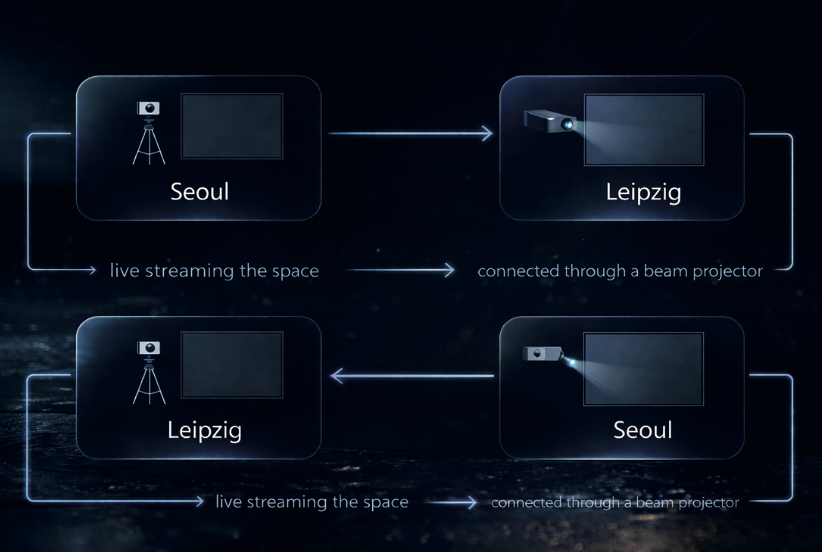
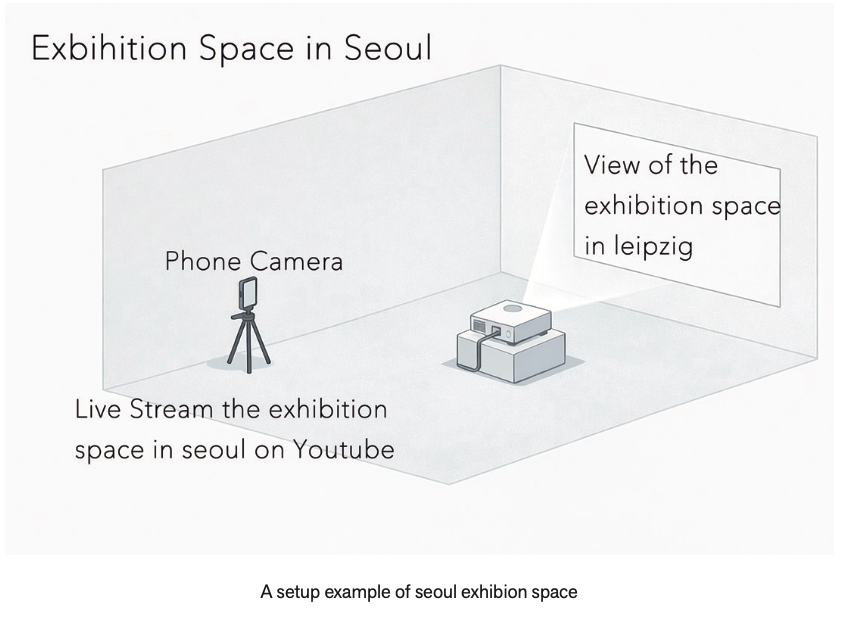
In both the Seoul and Leipzig venues, diverse and experimental works utilizing this dual exhibition format were presented. Each space streamed its exhibition live to the other in real time: the live feed from Seoul was projected onto a wall in Leipzig, and vice versa. Although physically separated, the two venues were visually connected, creating the sense of a shared, unified space. Each venue thus served not only as a physical site for installation, but also as a ‘transmission station’ that virtually links the two.
In both the Seoul and Leipzig venues, diverse and experimental works utilizing this dual exhibition format were presented. Each space streamed its exhibition live to the other in real time: the live feed from Seoul was projected onto a wall in Leipzig, and vice versa. Although physically separated, the two venues were visually connected, creating the sense of a shared, unified space. Each venue thus served not only as a physical site for installation, but also as a ‘transmission station’ that virtually links the two.
Within this expanded mixed-reality setting, viewers were able to navigate between both spaces in real time, interact with them, or experience all the works from either locations. A camera installed on a track continuously streamed the exhibition 24 hours a day. The physical venues remained closed to the public while being virtually accessible, revealing a non-interactive space in which no visitors are present and only the works remain illuminated. This setup dissolved physical separation while exposing, in raw form, the contingencies, interactions, and sensory collisions that occurred within it.
Viewers also had the ability to rewind the live stream to revisit past moments, expanding the simultaneity of live broadcasting into the asynchronicity characteristic of new media. This ‘making the invisible visible’ further destabilized the boundaries of time and space.
Preliminary Experiment for the Exhibition Format :
In this exhibition format, both the physical and virtual dimensions function as essential components. All online content is transmitted from a physical space, and the characteristics and conditions of that space shape the content itself. Alongside the exhibition format, careful attention must be given to types of works that, when presented within this system, can generate new forms of synergy. Participating artists therefore closely examine how their works function and are perceived within the physical environment. The time difference between the two cities was also a crucial factor to consider.
An inter-university program between the two cities, held from September to December 2025, served as a preliminary stage to experiment with installation and streaming methods, spatial interaction, and to identify potential technical challenges in advance.
In this exhibition format, both the physical and virtual dimensions function as essential components. All online content is transmitted from a physical space, and the characteristics and conditions of that space shape the content itself. Alongside the exhibition format, careful attention must be given to types of works that, when presented within this system, can generate new forms of synergy. Participating artists therefore closely examine how their works function and are perceived within the physical environment. The time difference between the two cities was also a crucial factor to consider.
An inter-university program between the two cities, held from September to December 2025, served as a preliminary stage to experiment with installation and streaming methods, spatial interaction, and to identify potential technical challenges in advance.
>>References
1. Chalmers Johnson, MITI and the Japanese Miracle: The Growth of Industrial Policy, 1925–1975 (Stanford, CA: Stanford University Press, 1982).
1. Chalmers Johnson, MITI and the Japanese Miracle: The Growth of Industrial Policy, 1925–1975 (Stanford, CA: Stanford University Press, 1982).
2. Youna Kim, Media Consumption and Everyday Life in Asia (London: Routledge, 2008)
3. Koichi Iwabuchi, Recentering Globalization: Popular Culture and Japanese Transnationalism (Durham, NC: Duke University Press, 2002).
4. Dal Yong Jin, New Korean Wave: Transnational Cultural Power in the Age of Social Media (Urbana, IL: University of Illinois Press, 2016).
5. “Wer politisch arbeitet, braucht keinen Computer.” taz – die tageszeitung, September 15, 2018. Accessed November 4, 2025. https://taz.de/Wer-politisch-arbeitet-braucht-keinen-Computer/!1817466/
More About Us :
The Project Team “Media Narrative Explorers” has been selected for the new prize “Respectively HGB” of Hochschule für Grafik und Buchkunst Leipzig and together with the HGB Friends e.V.
With this new award, the HGB, together with the HGB Friends e.V., promotes artistic and creative projects that are dedicated to the topic of “Studying at the HGB” and focus on social 'togetherness'. All HGB students were eligible to participate. A total of €5,000 was awarded, €1,000 of whic is prize money, €4,000 are earmarked for the realisation of the project. “Beziehungsweise HGB” will be awarded annually from now on.
Members of the jury were: Marie-Charlotte Elsner, Carla Maruscha Fellenz and Diva Lindenberg (HGB Student Council), Prof. Torsten Hattenkerl (Prorector HGB) and Steffen Woyth (Board Member HGB Friends e.V.).
A project description and further information on the prize can be found in the press release.